
Catalytic Leadership vs Traditional Leadership: What’s the Difference and Why It Matters
Leadership in a Changing World
The world of work has changed — dramatically. Hybrid teams, AI-driven innovation, generational turnover, and constant disruption have redefined what it means to lead effectively. The old command-and-control models that once worked in predictable environments are straining under the weight of complexity, speed, and human expectation.
Traditional leadership — the kind that centers on hierarchy, authority, and oversight — once ensured order and consistency. But today, that same rigidity can stifle creativity, limit agility, and erode engagement.
The modern workplace demands something more: leaders who can inspire transformation, not just manage performance. Leaders who can activate potential in others, build alignment around shared purpose, and accelerate change rather than resist it.
This is the essence of catalytic leadership — the evolution of leadership for a world that never stops evolving.
What Is Traditional Leadership?
Traditional leadership is rooted in control, structure, and predictability. It emerged from industrial-age management philosophies — think hierarchy charts, process manuals, and “supervisors” whose primary role was to ensure compliance and efficiency.
Core characteristics of traditional leadership include:
- Command and control: Leaders give instructions; employees follow them.
- Top-down decision-making: Strategy and innovation happen at the top.
- Focus on consistency and output: Success is defined by productivity, not potential.
- Preference for stability over experimentation: Change is managed, not embraced.
- Leader as “manager” or “director”: Authority is positional, not relational.
This model works best in environments where precision and compliance matter — manufacturing, healthcare, finance, or government sectors where mistakes can have high costs. In such contexts, clear lines of authority ensure consistency and safety.
But in today’s fast-moving, knowledge-driven world, these same structures can become barriers. They limit adaptability, discourage ownership, and create dependency on leadership for every decision. Teams become compliant rather than committed.
That’s where catalytic leadership takes the stage.
What Is Catalytic Leadership?
The word catalyst comes from chemistry — a substance that accelerates change without being consumed by it.
A catalytic leader does the same thing within an organization. They spark transformation, ignite growth, and accelerate progress through others — not by commanding, but by empowering.
Catalytic leadership is purpose-driven, people-centered, and progress-focused. It’s not about holding the power; it’s about distributing it.
Core traits of catalytic leaders:
- Empower rather than direct. They create clarity, then trust their teams to execute.
- Focus on purpose and growth. They connect daily work to meaningful outcomes.
- Encourage autonomy and accountability. Ownership builds motivation.
- Create alignment and shared ownership. Everyone understands both the what and the why.
- Act as accelerators of success. They remove barriers, spark collaboration, and amplify others’ strengths.
Catalytic leaders don’t just manage change — they activate it. Their presence accelerates learning, innovation, and alignment, leaving teams more capable and confident than before.
Key Differences Between Catalytic and Traditional Leadership
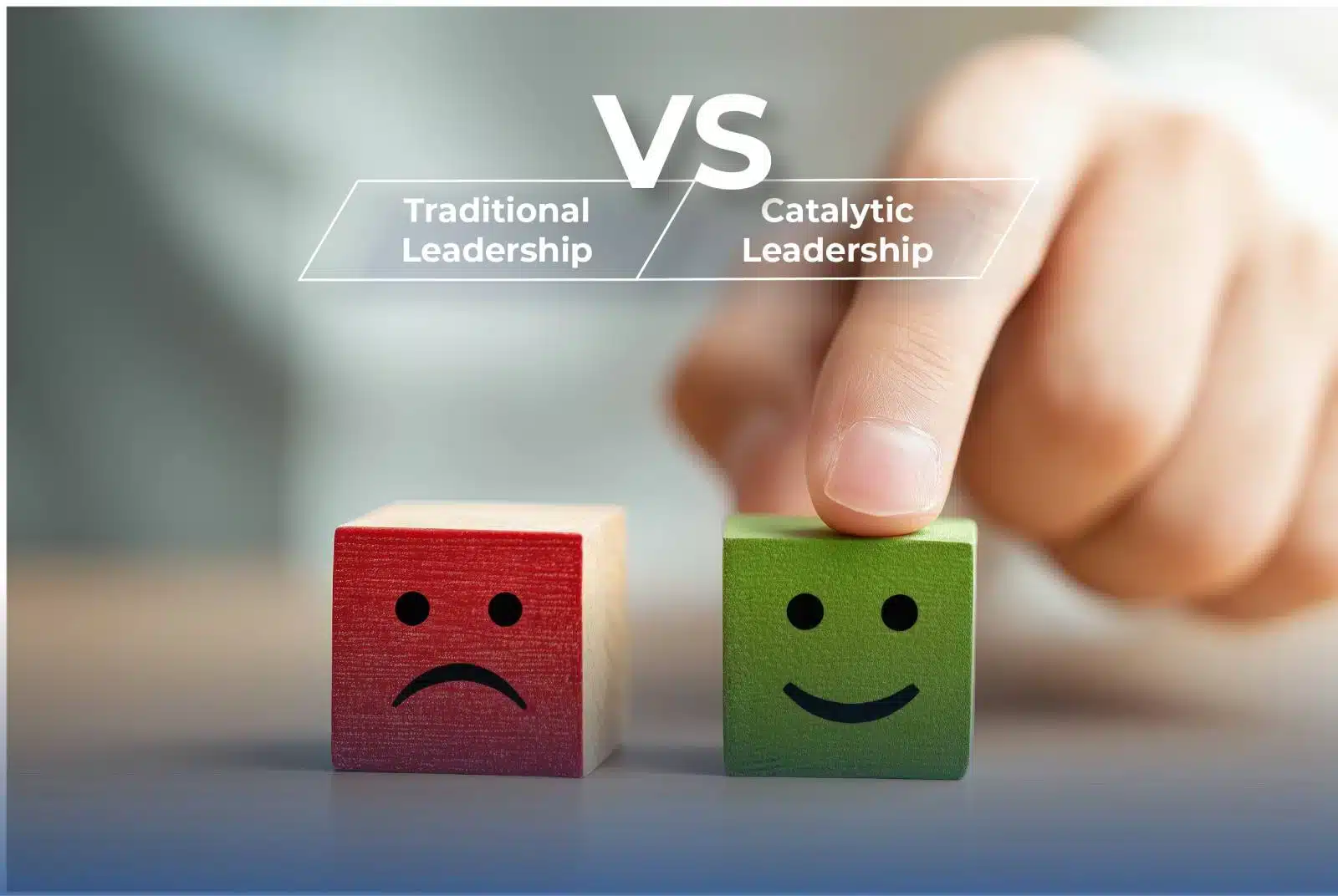
Traditional Leadership | Catalytic Leadership |
Focuses on control and compliance | Focuses on empowerment and growth |
Leader holds authority | Authority is shared and earned |
Decisions made at the top | Decisions made collaboratively |
Stability valued over innovation | Agility valued over predictability |
Leader manages people | Leader activates people |
Feedback is corrective | Feedback is developmental |
Motivation through direction | Motivation through purpose |
Employees follow | Teams co-create |
The shift from traditional to catalytic leadership isn’t cosmetic — it’s cultural. It transforms how organizations think, learn, and grow.
Why Catalytic Leadership Matters Today
The case for catalytic leadership has never been stronger. Modern organizations face three simultaneous pressures: speed, complexity, and human expectation.
- Speed and Agility
Markets shift overnight. AI tools redefine roles. Customer expectations evolve monthly. Traditional hierarchies can’t respond fast enough. Catalytic leaders empower their teams to make real-time decisions, adapting faster than bureaucracy ever could. - Complexity and Change
Leaders no longer face linear problems. They face ecosystems — of systems, stakeholders, and competing priorities. Catalytic leaders thrive here because they focus on principles, not procedures. They trust their teams to interpret strategy in context and innovate toward the goal. - Human Expectation
Employees want purpose, autonomy, and connection — not micromanagement. Gallup data consistently shows that people don’t quit companies; they quit managers. Catalytic leadership builds cultures of trust and belonging, directly driving engagement and retention.
The measurable impact:
Organizations that cultivate catalytic leaders see:
- Higher engagement and retention due to empowerment and trust.
- Faster innovation cycles because ideas can surface from anywhere.
- Stronger alignment across functions, as leaders connect strategy to purpose.
- Greater resilience in times of uncertainty, because teams can self-manage and adapt.
In short, catalytic leadership builds organizations that don’t just survive change — they harness it.
How Organizations Can Develop Catalytic Leaders
Becoming a catalytic leader isn’t about personality; it’s about practice. It’s not innate — it’s intentional. To develop catalytic leaders, organizations must design leadership growth by strategy, not chance. Here are five key steps to building a catalytic leadership culture:- Identify Leadership Potential Early
Catalytic leadership starts with potential, not position. Look for individuals who naturally influence, inspire, and collaborate. These are your future catalysts. - Build Self-Awareness Through Assessments and Feedback
Transformation begins with understanding oneself. Tools like 360° feedback, personality assessments, and emotional intelligence inventories help leaders uncover blind spots and develop empathy — a key catalytic skill. - Train Leaders to Coach, Not Command
Catalytic leaders ask questions before giving answers. They see their role as unlocking potential, not enforcing compliance. Coaching skills — listening, questioning, and guiding reflection — should be central to every leadership curriculum. - Encourage Peer Learning and Cross-Functional Collaboration
True catalysts build networks, not silos. Peer learning experiences — where leaders learn from one another — accelerate growth and alignment. Cross-functional collaboration expands perspective and agility. - Reinforce Purpose and Accountability
Catalytic cultures thrive when purpose is clear and metrics matter. Establish systems that connect goals to organizational mission and regularly celebrate progress toward both.
At developUs Worldwide, this philosophy is embedded in the Catalyst Leadership Program — an immersive experience designed to help leaders ignite growth and lead through others. Participants move beyond theory, developing the mindset and tools to drive transformation in real time.
Catalytic leadership isn’t about being louder or bolder — it’s about being clearer, braver, and more connected.
Traditional vs. Catalytic Leadership in Action
Let’s bring this to life with two short examples.
Example 1: Leading Through Change
A traditional leader faced with a new system rollout focuses on compliance: ensuring everyone completes training and follows new procedures. A catalytic leader, on the other hand, involves their team in shaping the rollout, asking: “What do you need to succeed?” They create shared ownership of the change.
Result: faster adoption, fewer errors, and higher morale.
Example 2: Developing Talent
A traditional leader identifies performance gaps and corrects them. A catalytic leader identifies potential and amplifies it. They delegate stretch projects, provide coaching, and celebrate growth along the way.
Result: higher retention, stronger bench strength, and a culture that breeds leadership at every level.
Becoming a Catalytic Organization
Catalytic leadership isn’t a single skill — it’s an ecosystem. When leaders model empowerment, agility, and purpose, those behaviors cascade throughout the organization.
A catalytic organization:
- Learns faster than competitors.
- Attracts and retains top talent.
- Moves with alignment even in uncertainty.
- Turns leadership into a multiplier effect instead of a management bottleneck.
This is leadership evolution — from managing people to mobilizing potential.
Conclusion: Be the Catalyst for Change
Traditional leadership builds order. Catalytic leadership builds progress.
In a world defined by complexity, speed, and human connection, the leaders who will shape the future aren’t the ones who demand control — they’re the ones who spark growth.
Ask yourself:
“Are my leaders managing change, or catalyzing it?”
The answer determines not just your organization’s culture, but its capacity to thrive in what’s next.
Learn More
Discover how the Catalyst Leadership Program from developUs Worldwide helps leaders ignite growth, accelerate alignment, and transform how teams lead together.
Because the question isn’t whether your organization has leaders —
it’s whether they’re catalysts.
Frequently Asked Questions — Sales Excellence Training
This program is ideal for sales professionals at any level — new reps, experienced sellers who want to sharpen their skills, and sales leaders looking to uplift team performance. The curriculum adapts to individual ability, industry context, and current sales maturity.
Unlike generic sales workshops, this course focuses on mindset first, then skill. Participants learn how to show up intentionally, qualify opportunities effectively, build trust, communicate value clearly, and navigate real-world sales conversations with confidence. It’s highly experiential and personalized to your sales environment. |
Yes. The training is designed to directly influence KPIs such as conversion rate, prospecting effectiveness, pipeline growth, relationship-building, and closing confidence. Participants learn practical tools they can apply immediately — often seeing measurable improvements within weeks.
The course blends instructor-led learning, real practice scenarios, mindset-building tools, assignments, and ongoing support. Delivery format (virtual, in-person, or blended) and duration can be customised based on your organisation’s needs.
Absolutely. Participants practice real conversations, receive guided feedback, and work through their individual blockers — helping them integrate new behaviors into their daily sales rhythm.
Yes. We tailor examples, role-plays, objection scenarios, and customer journey language to align with your sales process, products, and client expectations. This ensures the skills translate directly into your team’s real sales interactions.
Impact is measured through behavior shifts, confidence improvements, application of tools, and KPI tracking. Organizations can choose additional follow-up coaching, assessments, or reinforcement to maximise long-term results.
Leave a Reply