
Training Process Outsourcing: A Scalable Model for Global Workforce Development

Scaling learning across a global organization sounds simple on paper.
Standardize the content. Roll it out. Track completion.
But in reality, most organizations hit the same wall.
Training becomes fragmented across regions. Leadership expectations vary. Content gets duplicated, outdated, or ignored. And the internal team responsible for holding it all together is already stretched too thin.
This is where training process outsourcing shifts from a “nice to have” to a strategic decision.
Because scaling learning globally isn’t just about delivering courses.
It’s about building a system that works across people, cultures, and business goals.
Why Global Workforce Development Breaks Down
Let’s start with what typically happens inside growing organizations.
You expand into new regions. You hire more people. Leadership layers increase.
And suddenly:
- Training is inconsistent across teams
- Managers are developing people differently
- Leadership capability varies by region
- HR is overwhelmed trying to keep everything aligned
At first, these feel like operational issues.
But over time, they become business problems.
Because when development isn’t aligned:
- Performance becomes unpredictable
- Culture becomes diluted
- High-potential talent stalls or leaves
And the person expected to fix it?
Usually an HR or L&D leader who is already juggling ten competing priorities.
This is the exact point where many organizations begin exploring outsourcing training courses as a solution.
But not all outsourced training is created equal.
What Is Training Process Outsourcing?
Training process outsourcing goes beyond hiring a vendor to deliver a workshop.
It’s a partnership model where an external team designs, delivers, manages, and continuously improves your organization’s learning ecosystem.
Instead of asking:
“Who can run this training session?”
You’re asking:
“Who can own and scale our entire development strategy?”
This includes:
- Designing leadership and skills-based programs
- Delivering training across formats and regions
- Providing coaching and reinforcement
- Managing logistics, tracking, and optimization
- Aligning learning with business goals
In other words, it’s not about outsourcing a task.
It’s about outsourcing a capability.
And for many organizations, that shift changes everything.
The Limits of Traditional Outsourced Training
It’s important to address a common misconception.
Many companies believe they’ve already tried outsourced training.
They’ve hired facilitators. Purchased content libraries. Run external workshops.
And yet, results were minimal.
That’s because most outsourced training approaches are still:
- One-off engagements
- Content-focused instead of outcome-focused
- Disconnected from internal systems
- Lacking follow-up and reinforcement
So while the delivery is outsourced, the burden of making it “work” still sits internally.
That’s not true training process outsourcing.
That’s just external support.
A true TPO model removes that burden entirely.
What a Scalable TPO Model Actually Looks Like
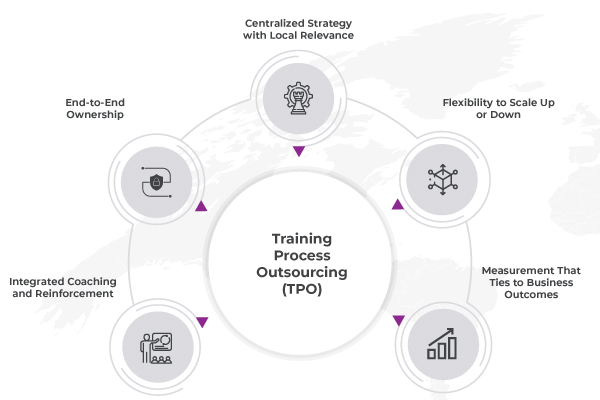
For organizations aiming to achieve leadership development worldwide, scalability requires more than consistency.
It requires integration.
A well-designed training process outsourcing model includes several key components.
-
Centralized Strategy with Local Relevance
Global organizations often struggle between two extremes:
- Fully centralized training that ignores local context
- Fully localized training that lacks consistency
TPO bridges that gap.
It creates a centralized strategy aligned to business goals, while adapting delivery to regional needs.
This ensures:
- Consistent leadership expectations
- Flexible delivery methods
- Cultural relevance without losing alignment
-
End-to-End Ownership
One of the biggest advantages of outsourcing training courses through a TPO model is ownership.
Instead of coordinating multiple vendors, internal teams, and platforms, a single partner manages:
- Program design
- Facilitation
- Coaching
- Measurement
- Iteration
This removes friction.
And more importantly, it frees internal teams to focus on strategy instead of execution.
-
Integrated Coaching and Reinforcement
Training without reinforcement rarely works.
A scalable TPO model builds coaching directly into the system.
This ensures that:
- Leaders apply what they learn
- Behavior change is supported over time
- Development becomes continuous, not episodic
This is especially critical for leadership development, where change happens through practice, not exposure.
-
Measurement That Ties to Business Outcomes
One of the biggest frustrations with traditional training is the lack of clear ROI.
TPO shifts measurement from:
- Attendance and satisfaction
To:
- Behavior change
- Performance improvement
- Business impact
This aligns development with what leadership actually cares about.
Results.
-
Flexibility to Scale Up or Down
As organizations grow, restructure, or shift priorities, learning needs change.
A strong outsourced training model provides flexibility.
You can:
- Scale programs across regions
- Adjust delivery formats
- Introduce new content quickly
- Support new leadership layers
Without rebuilding everything from scratch.
Who Benefits Most from Training Process Outsourcing?
Not every organization needs a full TPO model.
But when the conditions are right, the impact is significant.
Fast-growing organizations
Growth creates complexity.
TPO provides the structure needed to scale leadership capability alongside business expansion.
Companies with limited internal L&D resources
Many HR teams are expected to deliver transformation without the bandwidth to support it.
TPO brings in a full team of experts without the cost of building one internally.
Organizations with inconsistent training outcomes
If different regions or teams are developing leaders in different ways, alignment becomes impossible.
TPO creates consistency without sacrificing flexibility.
Businesses expanding globally
When operating across countries, languages, and cultures, development becomes exponentially harder.
A structured approach to leadership development worldwide ensures leaders are aligned, regardless of location.
What Changes When You Get It Right
When training process outsourcing is implemented effectively, the impact is both immediate and long-term.
Leaders become more consistent
They communicate better, manage performance more effectively, and align with organizational expectations.
Teams perform at a higher level
Because leadership improves, team dynamics and outcomes follow.
HR becomes more strategic
Instead of managing logistics, HR leaders can focus on driving business impact.
Learning becomes part of the culture
Not an isolated event, but an integrated system that supports growth at every level.
And perhaps most importantly:
Development starts to feel intentional instead of reactive.
Addressing Common Concerns About Outsourced Training
It’s natural to have hesitations about outsourcing something as important as learning and development.
Let’s address a few of the most common ones.
“Will an external partner understand our culture?”
A strong TPO partner doesn’t impose a system. They build one around your organization. Customization is not optional, it’s essential.
“Is this more expensive than building internally?”
In many cases, it’s more cost-effective. You gain access to a full team of experts without the overhead of hiring, training, and managing them.
“What if it doesn’t stick?”
This is exactly what TPO is designed to solve. With built-in reinforcement, coaching, and measurement, it addresses the gaps that cause most training to fail.
A Final Perspective on Scaling Learning Globally
If you’re responsible for developing people across regions, you already know this:
Content is not the problem.
Execution is.
Alignment is.
Sustainability is.
And trying to solve those challenges internally, without the right structure or support, often leads to burnout and inconsistent results.
That’s why training process outsourcing is gaining traction.
Not as a shortcut.
But as a smarter, more scalable way to build leadership capability across an entire organization.
Because when development is done right, it doesn’t just improve individuals.
It transforms how the business operates.
Scaling learning across regions requires more than content, it needs a system. Explore how DevelopUs supports global organizations through Training Process Outsourcing.
Frequently Asked Questions
Hiring external trainers usually means bringing someone in for a specific session or course. Training process outsourcing is much broader. It involves a partner owning the design, delivery, and ongoing management of your entire learning ecosystem.
It depends on the size and complexity of your organization. Some elements can be implemented quickly, while others are built over time. The goal isn’t speed alone, it’s building a system that actually works and scales.
Not if it’s done right. A strong TPO partner customizes programs to your culture, challenges, and goals. The experience should feel more relevant, not less.
It creates a consistent leadership framework while allowing for regional flexibility. This ensures leaders across different locations are aligned, without forcing a one-size-fits-all approach.
While it’s especially valuable for global organizations, mid-sized companies also benefit, particularly those experiencing growth or lacking internal L&D infrastructure. The key factor is complexity, not just size.
Leave a Reply